

SHEA BUTTER
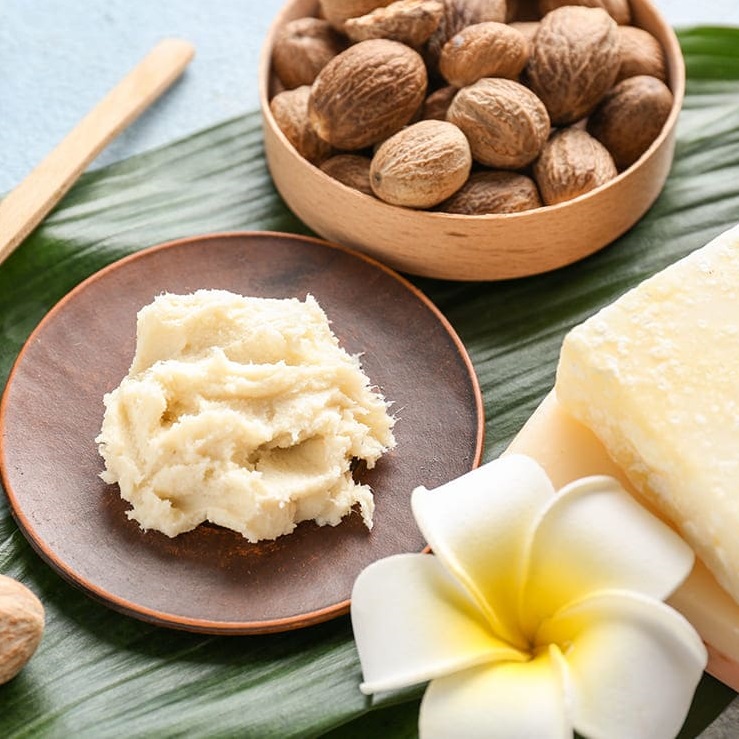
Shea butter is a vegetable fat extracted from the nuts of the shea tree
(Vitellaria paradoxa), a tree that grows primarily in West and Central Africa, in
regions such as Burkina Faso, Ghana, Mali, and Ivory Coast.
Shea butter is obtained through a traditional or industrial process:
Traditional method: The nuts are harvested, dried, crushed, roasted, and then
ground to obtain a paste. This paste is then kneaded with water to extract the
butter, which is then filtered.
Industrial method: More standardized, it often involves solvents or mechanical
presses for large-scale production.
Shea butter is solid at room temperature, with a creamy texture and a color
ranging from ivory white to pale yellow, depending on its degree of refinement.
Unrefined shea retains a slightly nutty odor, while refined shea is odorless and
smoother.
Uses of Shea Butter
In Cosmetics
Moisturizing: Used pure or in creams to treat dry skin, chapped skin, or eczema.
Lip Care: A common ingredient in lip balms to repair and protect.
Anti-aging : Reduces wrinkles and improves elasticity thanks to its antioxidants.
Sun protection: Provides mild UV protection (low natural SPF, around 6),
although it is not a substitute for sunscreen.
Baby Care : Soothes diaper rash and protects delicate infant skin.
Hair care
Nourishing: Repairs dry and damaged hair by sealing in moisture.
Protection: Coats the hair fiber to protect it from stresses (heat, pollution).
Scalp care: Soothes irritation and reduces dandruff.
Makeup : Used in foundations, lipsticks, and BB creams for a creamy texture
and moisturizing properties.
In traditional medicine
In Africa, shea butter is used to:
Treat inflammation and muscle pain thanks to its anti-inflammatory properties.
Treat burns, wounds, and scars thanks to its healing properties.
Relieve rheumatism and joint pain when applied topically.
In Food
In some parts of Africa, unrefined shea butter is used as an edible fat:
Replaces oil or butter in local cuisine.
Used in the manufacture of chocolate or confectionery as a substitute for
cocoa butter (although less common today).
Other uses
Soap Making: Used as a base in handmade soaps for its foaming and
moisturizing properties.
Candles and Household Products: Its solid texture makes it an ingredient for
natural candles or household balms.
Pharmaceutical Industry: Used as an excipient in certain medications or
ointments.
Shea butter is a vegetable fat extracted from the nuts of the shea tree
(Vitellaria paradoxa), a tree that grows primarily in West and Central Africa, in
regions such as Burkina Faso, Ghana, Mali, and Ivory Coast.
Shea butter is obtained through a traditional or industrial process:
Traditional method: The nuts are harvested, dried, crushed, roasted, and then
ground to obtain a paste. This paste is then kneaded with water to extract the
butter, which is then filtered.
Industrial method: More standardized, it often involves solvents or mechanical
presses for large-scale production.
Shea butter is solid at room temperature, with a creamy texture and a color
ranging from ivory white to pale yellow, depending on its degree of refinement.
Unrefined shea retains a slightly nutty odor, while refined shea is odorless and
smoother.
Uses of Shea Butter
In Cosmetics
Moisturizing: Used pure or in creams to treat dry skin, chapped skin, or eczema.
Lip Care: A common ingredient in lip balms to repair and protect.
Anti-aging : Reduces wrinkles and improves elasticity thanks to its antioxidants.
Sun protection: Provides mild UV protection (low natural SPF, around 6),
although it is not a substitute for sunscreen.
Baby Care : Soothes diaper rash and protects delicate infant skin.
Hair care
Nourishing: Repairs dry and damaged hair by sealing in moisture.
Protection: Coats the hair fiber to protect it from stresses (heat, pollution).
Scalp care: Soothes irritation and reduces dandruff.
Makeup : Used in foundations, lipsticks, and BB creams for a creamy texture
and moisturizing properties.
In traditional medicine
In Africa, shea butter is used to:
Treat inflammation and muscle pain thanks to its anti-inflammatory properties.
Treat burns, wounds, and scars thanks to its healing properties.
Relieve rheumatism and joint pain when applied topically.
In Food
In some parts of Africa, unrefined shea butter is used as an edible fat:
Replaces oil or butter in local cuisine.
Used in the manufacture of chocolate or confectionery as a substitute for
cocoa butter (although less common today).
Other uses
Soap Making: Used as a base in handmade soaps for its foaming and
moisturizing properties.
Candles and Household Products: Its solid texture makes it an ingredient for
natural candles or household balms.
Pharmaceutical Industry: Used as an excipient in certain medications or
ointments.