

ANNATTO SEED
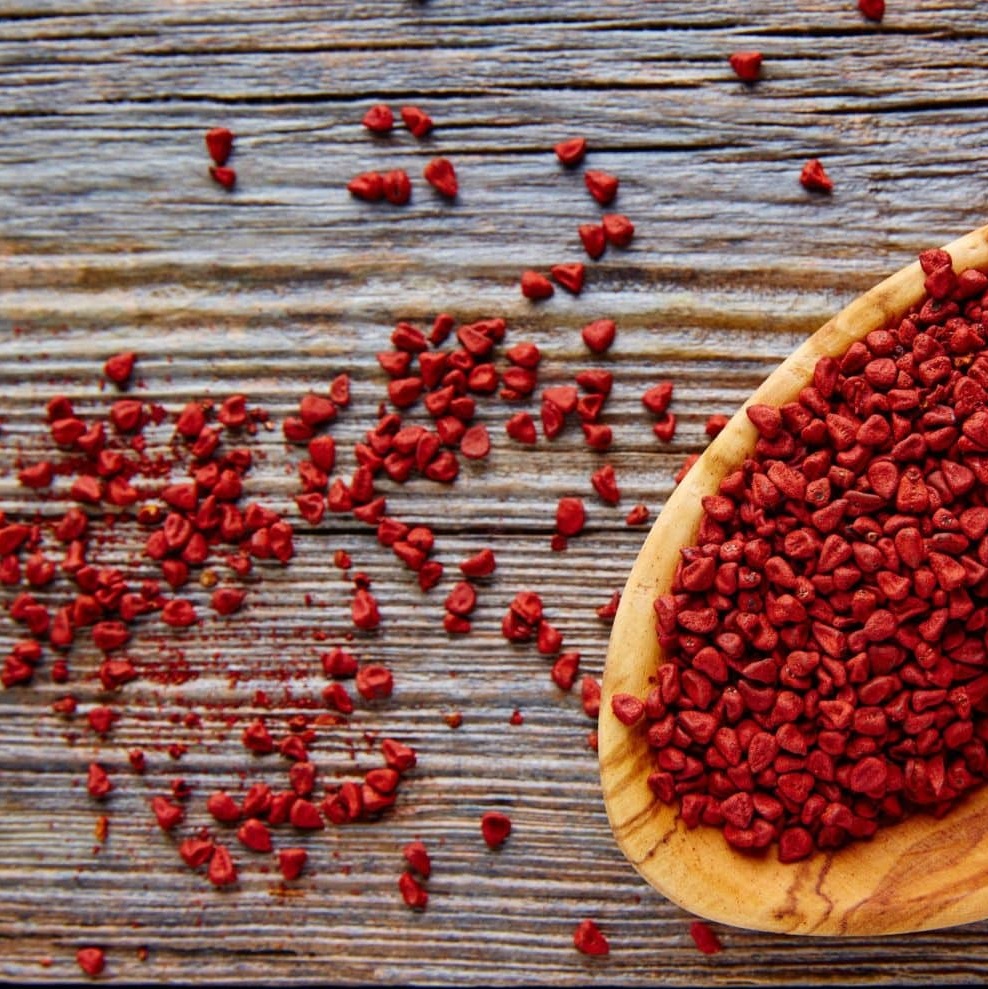
Annatto seeds come from the achiote tree (Bixa orellana), a tropical shrub or small tree in the
Bixaceae family, native to South America, probably from a region extending between the Guianas
and northeastern Brazil. Introduced by the Arawak and Carib peoples in the Antilles as early as the
9th century, it is now cultivated in tropical and subtropical regions, particularly in Central America,
the Caribbean, Africa (Kenya, Ivory Coast), Southeast Asia (India, Indonesia, the Philippines), and
Mexico.
The achiote tree produces spiny, heart-shaped capsules, green and then red when ripe, which split
open to reveal approximately 30 to 50 triangular red seeds surrounded by a pigment-rich wax.
The
term "annatto" refers to the tree, the seed, and the extracted dye, depending on the context.
Nicknamed the "lipstick tree," it owes its name to its traditional use as a body colorant by Native
Americans.
Nutritional Composition
Annatto seeds are rich in bioactive compounds, although their direct consumption is rare due to their
hard texture. Their value lies primarily in the wax that surrounds them, which is rich in carotenoids.
An analysis of the main components per 100g of seeds includes:
Carotenoids: Primarily bixin (fat-soluble, responsible for the red color) and norbixin (water-soluble,
yellow-orange color), representing up to 3.2g of provitamin A (beta-carotene), 100 times more than
carrots.
Vitamins: Vitamin E (antioxidant), traces of B vitamins.
Minerals: Calcium, magnesium, selenium, zinc, manganese, iron, potassium.
Other compounds: Ellagic acid (antioxidant), tannins, saponins, cellulose, tocotrienols (rare form of vitamin E), essential
oils.
Antimicrobial properties: Active against bacteria such as Escherichia coli, Staphylococcus, and
Listeria.
These compounds give annatto antioxidant, anti-inflammatory, healing, astringent, and UV-
protective properties.
Processing processes
Annatto seeds are hard and not directly edible. Their use requires specific processing:
Harvesting and drying: The ripe capsules are harvested, then the seeds are extracted and sun-dried
to remove the pigment-rich red wax.
Pigment extraction
Annatto oil: The seeds are gently heated in vegetable oil (olive, sunflower) or macerated for 3 to 7
days to obtain a reddish-orange colored oil. Aqueous infusion: The seeds are infused in hot water (1
hour) to release norbixin, which is used to color dishes or as a dye.
Powder: The seeds are ground (often after wax extraction) to produce a fine powder, easier to
incorporate into dishes or cosmetics.
Industrial processing
Bixin is extracted to produce the food coloring E160b (annatto), used in the food industry. This
process may include chemical solvents, which differentiates natural annatto from industrial coloring.
Note: The seeds must often be removed from dishes after infusion, as they remain hard and
tasteless.
Uses of annatto seeds
Annatto is a multifunctional ingredient, used in cooking, cosmetics, traditional medicine, and
industry. Here are its main applications:
- Culinary uses
Annatto seeds are prized for their coloring power and subtle flavor, described as peppery, earthy,
slightly musky, with hints of nutmeg and a hint of bitterness.
Food coloring: Used as a natural alternative to saffron or paprika, annatto colors yellow-orange or
red:
Cheese: Mimolette, Cheddar, Edam, Livarot, Boulette d'Avesnes.
Smoked fish: Haddock.
Industrial products: Butters, margarines, sauces, candies, ice cream, chocolates.
Cosmetic uses:
Annatto oil is a prized ingredient for its protective and antioxidant properties:
Sun protection: Rich in beta-carotene, it stimulates melanin production, preparing the skin for
tanning and providing moderate UV protection.
Annatto seeds come from the achiote tree (Bixa orellana), a tropical shrub or small tree in the
Bixaceae family, native to South America, probably from a region extending between the Guianas
and northeastern Brazil. Introduced by the Arawak and Carib peoples in the Antilles as early as the
9th century, it is now cultivated in tropical and subtropical regions, particularly in Central America,
the Caribbean, Africa (Kenya, Ivory Coast), Southeast Asia (India, Indonesia, the Philippines), and
Mexico.
The achiote tree produces spiny, heart-shaped capsules, green and then red when ripe, which split
open to reveal approximately 30 to 50 triangular red seeds surrounded by a pigment-rich wax.
The
term "annatto" refers to the tree, the seed, and the extracted dye, depending on the context.
Nicknamed the "lipstick tree," it owes its name to its traditional use as a body colorant by Native
Americans.
Nutritional Composition
Annatto seeds are rich in bioactive compounds, although their direct consumption is rare due to their
hard texture. Their value lies primarily in the wax that surrounds them, which is rich in carotenoids.
An analysis of the main components per 100g of seeds includes:
Carotenoids: Primarily bixin (fat-soluble, responsible for the red color) and norbixin (water-soluble,
yellow-orange color), representing up to 3.2g of provitamin A (beta-carotene), 100 times more than
carrots.
Vitamins: Vitamin E (antioxidant), traces of B vitamins.
Minerals: Calcium, magnesium, selenium, zinc, manganese, iron, potassium.
Other compounds: Ellagic acid (antioxidant), tannins, saponins, cellulose, tocotrienols (rare form of vitamin E), essential
oils.
Antimicrobial properties: Active against bacteria such as Escherichia coli, Staphylococcus, and
Listeria.
These compounds give annatto antioxidant, anti-inflammatory, healing, astringent, and UV-
protective properties.
Processing processes
Annatto seeds are hard and not directly edible. Their use requires specific processing:
Harvesting and drying: The ripe capsules are harvested, then the seeds are extracted and sun-dried
to remove the pigment-rich red wax.
Pigment extraction
Annatto oil: The seeds are gently heated in vegetable oil (olive, sunflower) or macerated for 3 to 7
days to obtain a reddish-orange colored oil. Aqueous infusion: The seeds are infused in hot water (1
hour) to release norbixin, which is used to color dishes or as a dye.
Powder: The seeds are ground (often after wax extraction) to produce a fine powder, easier to
incorporate into dishes or cosmetics.
Industrial processing
Bixin is extracted to produce the food coloring E160b (annatto), used in the food industry. This
process may include chemical solvents, which differentiates natural annatto from industrial coloring.
Note: The seeds must often be removed from dishes after infusion, as they remain hard and
tasteless.
Uses of annatto seeds
Annatto is a multifunctional ingredient, used in cooking, cosmetics, traditional medicine, and
industry. Here are its main applications:
- Culinary uses
Annatto seeds are prized for their coloring power and subtle flavor, described as peppery, earthy,
slightly musky, with hints of nutmeg and a hint of bitterness.
Food coloring: Used as a natural alternative to saffron or paprika, annatto colors yellow-orange or
red:
Cheese: Mimolette, Cheddar, Edam, Livarot, Boulette d'Avesnes.
Smoked fish: Haddock.
Industrial products: Butters, margarines, sauces, candies, ice cream, chocolates.
Cosmetic uses:
Annatto oil is a prized ingredient for its protective and antioxidant properties:
Sun protection: Rich in beta-carotene, it stimulates melanin production, preparing the skin for
tanning and providing moderate UV protection.